
The familiar story of the British high street is usually told through what has disappeared.
Banks have closed. Department stores and national chains have withdrawn. Shopping habits have moved online. Buildings once occupied by household names have remained empty for months or years, leaving gaps that are physically prominent and emotionally difficult for towns that remember them at their busiest.
That story is real, but it is incomplete.
Across South Wales, there is now a more revealing question. What is taking its place?
Recent changes in Pontypridd, Treorchy and surrounding towns suggest that the high street of the future will depend less on conventional shopping. Hospitality, personal services, independent food and community activity are becoming more important. So are events, public spaces and smaller businesses that give people a reason to stay rather than simply complete a transaction.
Not every new café represents regeneration. Restaurants cannot fill every vacant shop. Even so, the purpose of the town centre is clearly changing. We can now see that change building by building.
This article follows TownConnect's earlier piece: Are South Wales High Streets Really Dying or Just Changing?. This time, we look at what that change feels like on the ground.
Pontypridd is turning former retail space into places to spend time
The transformation of the former Marks & Spencer site in Pontypridd is perhaps the clearest local example.
For generations, a large department store represented confidence in a town centre. It drew regular footfall and gave neighbouring businesses a share of the activity. When such a store closed, the empty building became a visible measure of decline.
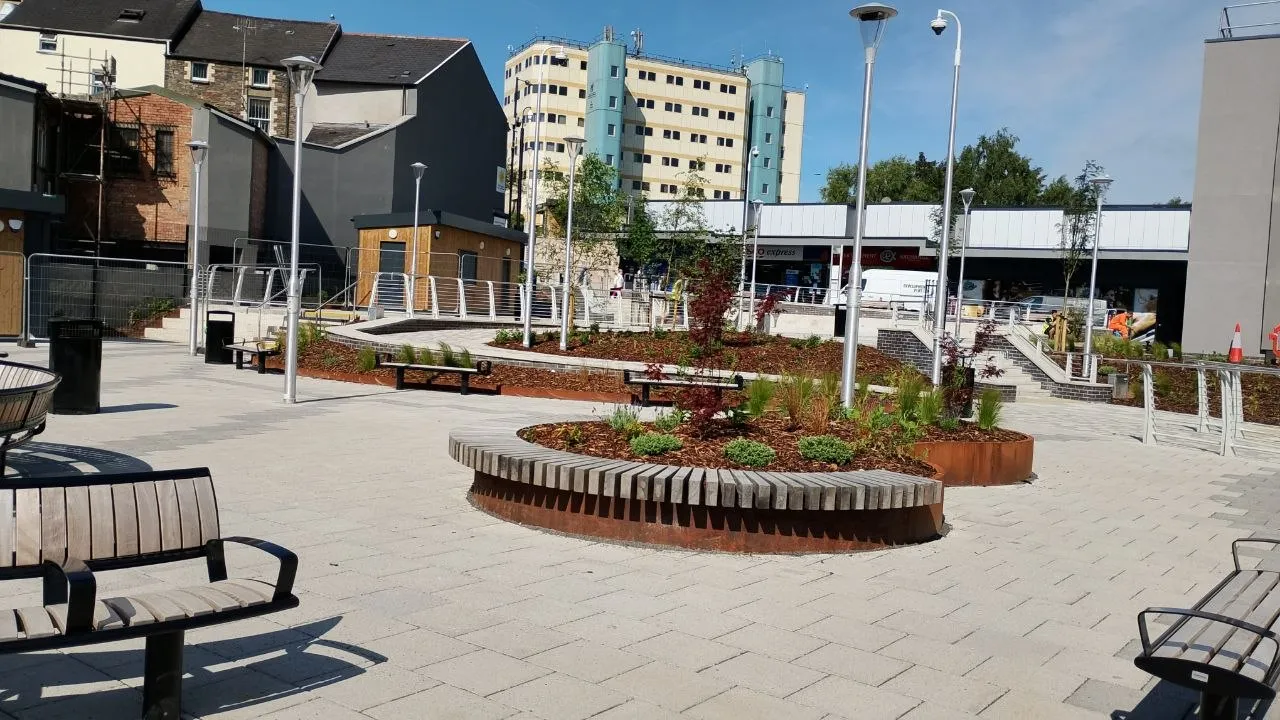
The replacement does not try to recreate the same retail model. Rhondda Cynon Taf Council has redeveloped the former M&S site as a riverside public space. This has opened the town towards the River Taff for the first time in more than a century. The plaza opened in summer 2026 and food and drink kiosks form part of the wider plan.
That change is symbolically important. A private retail destination has been replaced by public realm, events potential and smaller hospitality units. Instead of relying on one large operator to attract shoppers, the site is being asked to generate activity through movement, social use and time spent in the centre.
It is too early to judge the lasting commercial effect. Public space does not automatically create customers. Attractive paving cannot make up for weak transport, poor maintenance or too many empty units nearby. The kiosks will also need suitable operators and enough demand throughout the year.
But the direction is clear. Pontypridd is being redesigned around experience and dwell time as well as retail.
Former banks are becoming part of the hospitality and community economy
Another proposal shows the same shift in a different way.
The former Barclays building on Taff Street has been empty since the bank closed in 2023. Plans have proposed turning part of the ground floor into a café and restaurant with conference and meeting rooms. The plans also describe training, work experience and employment for people supported by Developing a Caring Wales. Flexible rooms could be used for community and recovery support.
At the time of writing, this should be understood as a proposal rather than an established venue. Nevertheless, the intended use is revealing.
A bank once brought people into town to carry out financial transactions. Online banking removed much of that need. The proposed replacement combines food, meetings, training and social support. These activities still benefit from people meeting in a real place. They cannot be moved to an app in quite the same way.
This is one of the main patterns shaping town centres. Businesses are more likely to need high street space when they offer an experience or a service in person. They may also give people somewhere to meet.
Pontypridd Market shows that food can renew an older commercial format
Change does not always require replacing a historic structure. Sometimes it means adapting what is already there.
Pontypridd Market remains one of the town's most distinctive commercial assets. Its food offer now combines traditional operators with smaller businesses built around more specialised products and informal eating.
Giovanni's Italian Paninis, for example, serves homemade paninis, arancini, Italian coffee and desserts from a compact market stall. It is modest compared with a full restaurant, but that is part of its appeal. A market can give a focused independent business a place in the town centre without the cost and commitment of a large unit.
The wider Market Quarter includes butchers, bakers, deli products, Indian street food and cafés. It gives people several reasons to visit the same building. They can buy ingredients, collect lunch, meet somebody for coffee or try something that is not easily reproduced in a supermarket aisle.
Food is not merely filling space here. It is helping the market serve both its traditional function and a newer social one.
That blend may be more resilient than attempting to choose between heritage and reinvention. The market remains recognisably a market while accommodating the kinds of operators and customer habits that are growing now.
Treorchy demonstrates what independent hospitality can add
Treorchy has already received national attention for the strength and identity of its high street. Its more recent openings show why independent hospitality has become such a visible part of town centre change.
The Fern & Ivy occupies a former car parts store on Treorchy High Street. It is now a restaurant and cocktail bar with space for private events with acquired, ambitious and talented chefs who aim to make a difference. The business is also a social enterprise. Its aim is to reinvest profits into work that supports children, families and communities across the Rhondda.
The significance is larger than one restaurant opening.
The project gives an existing building a new use and a new public identity. It brings evening activity to the street. It gives people a reason to visit for an occasion rather than an essential purchase. The commercial activity also supports a wider community purpose.
Not every independent business can or should follow that model. Restaurants face high food, staffing and energy costs. Evening venues also depend on transport, customer confidence and repeat visits. An impressive opening does not prove that a business will last.
Even so, The Fern & Ivy represents the kind of locally distinctive development that a national chain could not reproduce in quite the same way.
Smaller Treorchy businesses add to the same mix. Cloud Nine Coffee & Kitchen offers breakfast and brunch. The Crepe Project] has a more specialised café menu. Older cafés and newer operators give people several reasons to move along the street rather than visit one place and leave.
Nearby, venues such as Lunar Coffi and Co in Treherbert show that this pattern is not confined to the largest town centres. Small hospitality businesses can add visible activity and a place to meet even where the surrounding commercial market is limited.
The new high street is increasingly built around things the internet cannot deliver
The common thread is not food by itself. It is physical experience.
Online retail is exceptionally good at helping people compare products, find stock and arrange delivery. Online banking can complete routine transactions without a branch. Many administrative services can be handled from home.
The internet cannot fully reproduce:
- meeting a friend for coffee
- eating somewhere with a particular atmosphere
- attending an event
- browsing a market and speaking to traders
- receiving a haircut, treatment or repair
- using a shared civic space
- taking part in local training or community activity
- discovering several independent businesses during one visit
The businesses surviving and opening on high streets increasingly cluster around those activities.
This helps explain why hospitality, beauty, fitness, leisure and professional services have become more prominent as conventional retail has contracted. Their advantage is not that they are immune to the internet. Their core service still needs people and a physical place.
More cafés do not automatically make a balanced town centre
It is tempting to treat every restaurant opening as an uncomplicated sign of recovery. The reality is more difficult.
Hospitality can encourage people to stay longer. It can bring empty buildings back into use and support an evening economy. It can also become oversupplied. Several cafés competing for the same daytime customers do not necessarily create more demand. This is especially true in towns with limited disposable income or weak weekday footfall.
Restaurants and bars are vulnerable to energy costs, staffing problems, food inflation and changing consumer confidence. Their visible openings can be followed by equally visible closures.
A functioning town centre still needs to be useful every day. Residents need pharmacies, food shops, banking alternatives (which disappear due to way we bank and bank cut costs), transport and public toilets (sic!). They also need accessible parking spaces, sidewalks, health services, repair businesses and affordable places to buy ordinary goods. A centre filled only with leisure destinations may look lively on a Saturday evening but remain inconvenient during the week.
The strongest future is therefore not “retail out, restaurants in”. It is a better mixture.
Hospitality works best alongside useful services, independent shops, homes, workplaces and culture. Public space and reliable transport matter too. Each gives people a different reason to visit.
Regeneration projects need businesses - and businesses need the surrounding town
Public investment can remove derelict structures, improve streets and make difficult sites usable. RCT's recent programme includes the Pontypridd riverside plaza, Llys Cadwyn, Y Muni and YMa. It also includes Porth Transport Hub and further plans in Aberdare and Pontypridd.
Those interventions matter because individual small businesses cannot rebuild public space, reorganise transport or rescue large derelict buildings alone.
But construction is only the beginning. A regenerated site succeeds when people use it often and nearby businesses benefit. That depends on maintenance, safety, events and transport. Rents, business support and local demand matter as well.
The relationship works in both directions. New public space can help independent venues. Independent venues make the public investment feel active rather than cosmetic.
This is why individual openings matter. A town centre strategy can feel distant on paper. It becomes real when the lights come on in an empty unit, people find work there and customers begin walking through the door.
Independent openings give towns character, but visibility remains a problem
National chains provide familiarity, marketing reach and operational scale. Independents provide something equally important: difference.
A town filled with the same businesses found everywhere else gives visitors little reason to choose it. Markets, specialist food, community ventures and locally owned venues can create an identity that belongs to the place.
Yet independent businesses often have less time and money for marketing. An opening may attract attention on social media for a few weeks, then become difficult to discover outside the owner's existing network. Details can end up scattered across Facebook posts, map listings and outdated web pages.
That is one reason TownConnect links Journal coverage with local listings. Readers interested in the wider changes can move from the analysis to information about actual places, while the listings gain context that a name, address and category alone cannot provide.
Explore restaurants and food businesses, cafés and coffee shops
What should we look for next?
The next stage of change on the high street cannot be measured only by occupancy rates.
Useful questions include:
- Are empty landmark buildings returning to sustainable use?
- Are new venues still trading after the initial attention has passed?
- Does public investment increase visits to surrounding independent businesses?
- Are town centres active at different times of day?
- Is the business mix useful to residents as well as attractive to visitors?
- Can people reach the centre easily without depending on one mode of transport?
- Are rents and unit sizes suitable for new independent operators?
- Do new developments create local employment and routes into training?
- Are neighbouring towns developing distinct identities or competing for the same limited demand?
These questions produce a more honest assessment than counting openings alone.
The old high street is not coming back, but something else is already appearing
South Wales town centres are unlikely to return to the retail structure many people remember. Banks will not reopen simply because their buildings remain. Department stores will not recover the role they held before online shopping. Large chains will continue to make decisions according to national economics rather than local sentiment.
But decline is not the only possible outcome.
Pontypridd's riverside plaza, the proposed reuse of its former bank and the evolving food offer in the market all point towards a different kind of centre. Treorchy's independent hospitality venues do the same. This new model is more fragmented and perhaps less predictable. It relies on many small operators rather than a few dominant names. Commercial, civic and community purposes often sit side by side.
That transition carries risks. Hospitality alone cannot support every unit, and regeneration cannot be declared complete when construction finishes. Some experiments will fail.
The opportunity is that town centres can become more local precisely because the old standardised model is weakening.
The high street cannot be preserved unchanged. The real question is whether the businesses, buildings and public spaces replacing the old model can form something useful and distinctive. It also needs to be durable enough to earn regular support.